

“Light the trees” can describe several different displays. Two trees of about the same height can call for very different amounts of lighting depending on trunk size, how the branches spread and how far you want the light to reach. So before you compare estimates, settle three questions: How far up the trunk should the wrap go? Should the lights continue onto the branches? And how much of the crown do you want lit?
A reference photo with the parts you like pointed out usually does more good than asking for a tree to be “fully wrapped.” Here are the three main looks, roughly in order of coverage, plus how color and a few scope details shape your quote.
Trunk wraps: strong vertical lines through the yard
Wrapping only the trunk emphasizes the tree’s vertical line. Along a driveway, a front walk or a lawn with several trees, those repeated columns of light give the whole yard a steady rhythm, and the look stays clean because the crowns remain dark.
The detail that matters most is where the wrap stops. “Below the first major branch,” “to the first fork” or “a few feet into the main limbs” are all clear instructions; “wrap a few trees” is not. Also think about where people will actually stand. If shrubs or a low wall hide the lower trunk from the street, a wrap that stops low may barely show from the curb, and you may want the lights to start higher or continue farther up.
Trunks plus selected branches: show the tree’s shape
Carrying the lights from the trunk onto the major limbs makes the tree’s structure part of the display. The featured photo at the top of this article shows a row of trees beside a sidewalk with warm-toned lights wrapping the trunks and many of the spreading branches. Because the lit forks connect to one another, the trees read as a single pattern rather than a line of separate posts.
This approach works well when the branching itself is something you want people to notice, which is often the case with a mature shade tree in the front yard. Tell us which main limbs should be included and how far along each one the lights should run. Lighting three or four prominent branches and lighting a dozen smaller ones are very different amounts of work and material, even on the same tree.
Leave some darkness in the composition. A clearly lit trunk and a handful of well-chosen limbs create a shape the eye can follow without every twig being covered.
Broader canopy coverage: a fuller field of light
A canopy effect pushes the visible lighting farther out across the tree’s spreading structure. When several trees along a walk are lit this way, the branches overhead start to feel like a lit ceiling along the route.
Keep in mind that “canopy lighting” isn’t a precise specification. One homeowner means wrapped main limbs; another means light spread across most of the crown. Point to a photo and name the parts you like so the estimate describes the same result you’re picturing.
Your tree’s structure and the access around it also affect what we can propose. A broad, mature tree with heavy limbs and a young ornamental near the porch won’t take lighting the same way, and an example from a different property can’t always be reproduced at the same scale. Ask what coverage is realistic for your actual trees rather than assuming.
Using color to tie a group of trees together
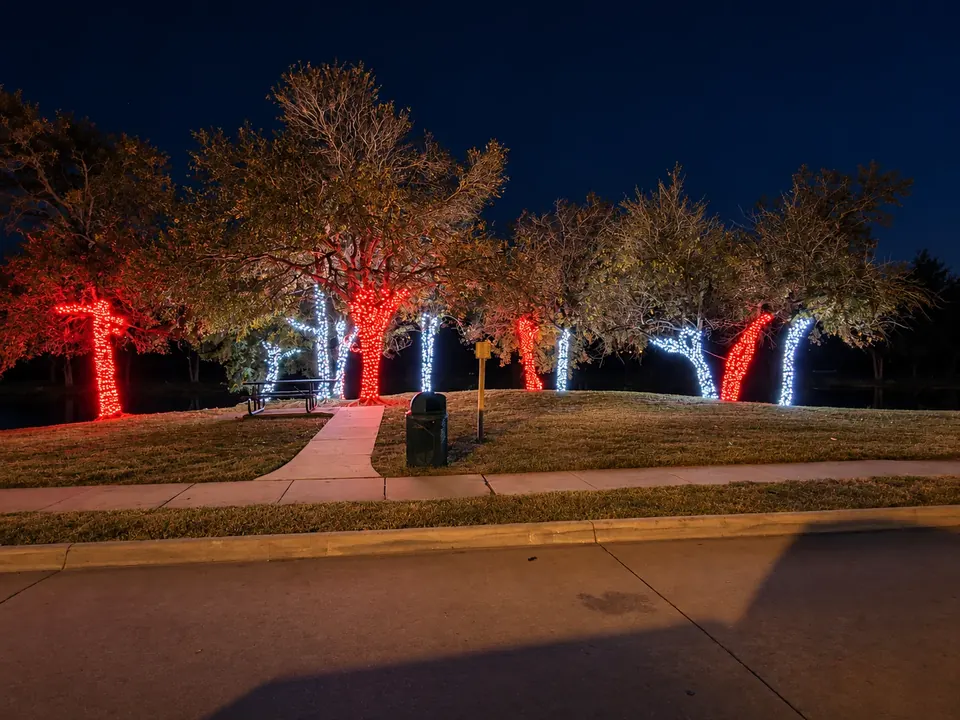
A single white tone gives a group of trees a consistent, quiet look. Alternating whole trees in two colors, as in the red-and-white project photo above, adds color to the grouping without mixing every color on every trunk. Notice that the upper foliage in that photo stays mostly dark: it’s a good example of trunk-plus-selected-branch coverage, not a full canopy.
Decide whether the trees should match the house or stand on their own as a focal point. If your roofline is already colorful, white tree lighting makes a calmer companion. If the house is simple, a colored group of trees can carry the seasonal accent by itself. Our white-light color guide can help you put words to the tone you prefer before you send a request.
Why two tree-lighting quotes can look so different
Each season’s price comes down to the quantity of lights, including linear footage, and the style and location of the lighting. On trees, that translates into a few specifics:
- Number of trees and which ones are included
- Trunk size, since a thick trunk takes more footage per foot of height than a slender one
- Wrap height and whether lights continue onto branches
- Branch coverage: a few main limbs, many limbs or most of the crown
- Density of the wrap, from loose spirals to tight coverage
- Color and whether all trees match
- Access, such as gates, beds, fences or landscaping around the base
A broad mature tree with several lit branches is simply not the same job as a narrow trunk of the same overall height, which is why two quotes for “three trees” can land far apart.
Bulb size shapes the look too. Our website identifies commercial-grade C9 bulbs, and industry product guides describe mini LED strings as small repeated points of light suited to greenery (Christmas Designers). What actually goes on your trees depends on the products in your quote, so ask which lights are proposed if you have a particular size in mind.
If you lease the lights through us, they remain our property, and we store them after removal, so there’s nothing to untangle in your garage next year. Ask us to confirm the attachment and removal approach for the trees being decorated so you know what to expect at both ends of the season.
To get an accurate estimate, send wide photos that show each whole tree and the ground around it, plus a closer shot of the trunk and the main forks. Mark which trees are in and which are out. October is generally a good time to book a first install; November can still work, and December usually offers fewer dates and options.
An example of a clear tree-lighting request
“Three front-yard trees in warm white, wrapping the trunks to the first fork and continuing along the main visible branches. We want the group to be seen from the street and to coordinate with a white roofline.”
That’s a way of describing a design, not a fixed package. Photos and a property review determine the final scope.
Pick the look, then let’s talk trees
Browse our tree-lighting photographs and read about our Christmas installation service to narrow down the effect you want. If you’re planning for an office park, storefront or community entrance instead of a home, our commercial lighting service covers those properties.
When you’re ready, request a free estimate. Text is easiest: send your address, a few tree photos, the look you’re after and your preferred timing to (214) 557-7809, or email sales@texaspremierlighting.com. We’ll confirm availability for your property and tell you what’s realistic for your trees.