
Getting a commercial holiday display right has less to do with the lights than with the brief you hand the installer. The strongest brief names one person who approves the design and one who handles property access, lists every area you want lit, keeps your desired “ready by” date separate from the confirmed installation appointment, and states up front what you expect for maintenance checks and takedown. Get those pieces down first and the estimate comes back faster, with fewer rounds of “did you mean this entrance or that one?”
Here’s how to build that brief for an office, storefront, or community property.
Start with one approver and one access contact
Decide who signs off on the design and who can let a crew onto the property. On many properties these are different people: a marketing lead or board member picks the look, while a facilities manager or gate attendant controls entry. Both names belong in the brief.
Gather opinions before you send it, not after. If the office team, tenants, or community representatives all have input, collect it and settle on one agreed set of instructions. An installer working from three sets of emails will build the wrong thing for at least two of them.
Include the full street address, a few property photos, the date you want the display finished, and any events tied to it—a tenant appreciation night, a tree lighting, the first weekend of extended shopping hours. Note which entrance customers or residents actually use, since it isn’t always the one on the plans.
Name every area instead of “the property”
“Decorate the building” is a request. “Outline the roof edge over the main entrance and wrap the two oaks in the front bed” is a plan. Break the site into individual areas and describe each on its own. The table below shows what to gather for three kinds of property.
| Space | What to describe | Access details to include |
|---|---|---|
| Office interior | The rooms or zones involved, such as reception or a shared gathering area, with photos and a preferred style. | Who arranges entry, when the space is free, and any other work or events scheduled there. |
| Storefront entrance | The customer entrance, the specific roof edges you want lit, and any trees or other features. | Business hours, delivery windows, parking, and which walkways or drive lanes must stay open. |
| Community property | Each entrance, pavilion, tree group, or gathering area as a separate line item. | The approval contact, gate codes or access arrangements, common-area schedules, and community event dates. |
We handle commercial holiday lighting and office-interior decorating for businesses, storefronts, and community properties. A named list of areas lets us quote each one clearly, and the final proposal is what defines the work included—so if an area isn’t in it, it isn’t in the job.
Borrow features from a real photo, not “the same look”
Reference photos help, but “make ours look like that” leaves too much open. Break the photo into features you can point to.
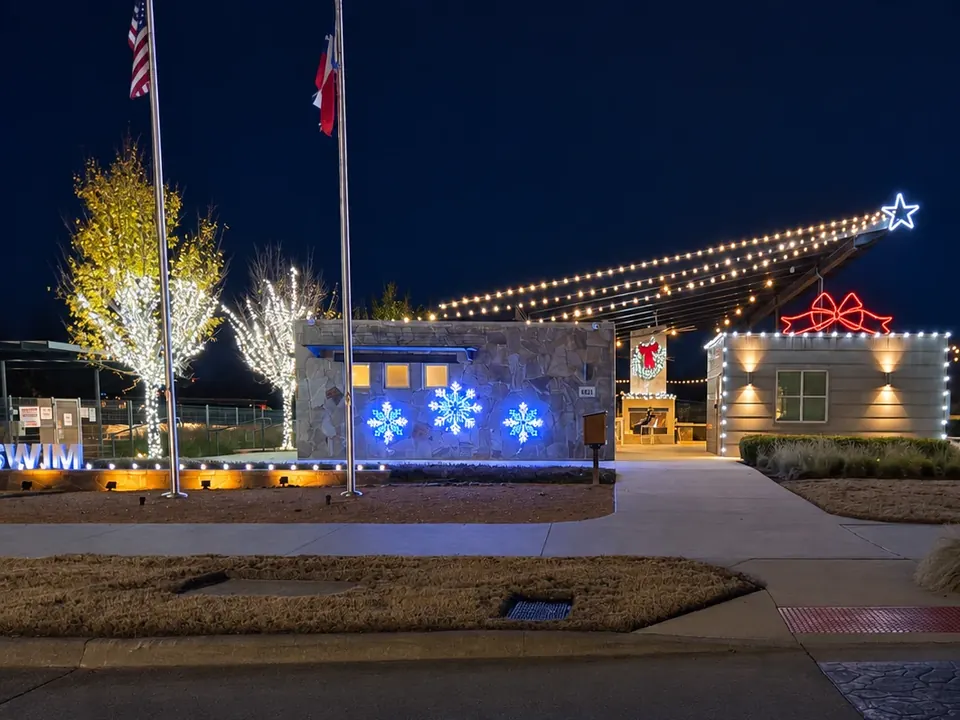
In this gallery photo, light strands form an elevated sloping structure above a shared entrance, white lights trace the building edges, blue snowflake decorations brighten the building facade, a red bow anchors the display, and the nearby trees are wrapped. The concrete approach stays clearly separate from the planted areas, which is part of why the scene reads cleanly at night.
A brief built from that photo would say something like: “Highlight the pavilion roofline, outline the building edges in white, add blue snowflake accents, and let’s discuss wrapping the trees along the walkway—marked on the attached property photo.” That’s a planning example drawn from what’s visible, not a record of the original client’s request.
Browse our commercial project gallery and note which features and colors you like from each photo. If you’re unsure how to describe the palette, our lighting color guide explains the difference between warm white and cool white so you can say what you want without asking for an exact copy of another property.
Keep your ready date separate from the appointment
Your brief should carry two dates: the day you want the display finished, and the installation appointment once it’s confirmed. They’re not the same thing until we’ve checked availability for your address and agreed on a schedule.
For planning purposes, October is generally a good time to book a first commercial project, November can still work, and December usually offers fewer dates and options. Treat that as a general expectation, not a deadline or a live calendar. If your ready date is tied to an event, say so; it helps us sort out what has to be finished first if the install runs across more than one visit.
If you’re also considering Halloween lighting for the same property, mention it in the same conversation. We can discuss both seasons together and confirm scope and availability for each.
Put it all on one worksheet
The template below pulls everything above into one document you can copy into your notes or paste into a message. Fill out the property section once, repeat the area block for each space, and finish with the seasonal handoff details.
Keep a single current version. Installation, mid-season maintenance, and removal often need different access arrangements, and if the person responsible for the property changes during the season, update the contact so a crew isn’t calling someone who moved offices in November.
Decide now what happens after the lights are up
A display that looks great on installation night should still look great in mid-December. On commercial projects we use commercial-grade lighting and equipment, and routine quality checks and maintenance are available upon request. That last phrase matters: a specific inspection frequency or response time isn’t built into every display, so tell us what your property needs—a check before a major event, for instance, or a walkthrough after a windy week—and we’ll discuss it as part of the plan.
If you lease the lights from us and one goes bad during the season, it’s replaced at no charge under our warranty. When something needs attention, the maintenance and removal guide includes a ready-to-copy issue report and the handoff details your reporting contact will need.
Plan the takedown before the lights go up
Removal is easier to schedule in October than to improvise in January. Record any event or operating requirement that affects when the display should come down, who can coordinate entry for the crew, and which installed features are part of the removal scope. A preferred takedown date needs confirmation just as an installation date does.
If your lights are leased, they remain our property and we store them after removal, so there’s nothing for your facilities team to box up or find closet space for.
Send the brief
Check our service area—we work across North Texas from roughly Colleyville to Kaufman—and send the full property address so we can confirm availability for that specific location, not just the city.
When you’re ready, request a free estimate with your address, the areas you want lit, a photo or two, and your preferred timing. Prefer to skip the form? Text (214) 557-7809 and we’ll follow up about the project.