
A big tree gets noticed. Whether it works for your property depends less on how tall it is and more on a handful of decisions made before anything is delivered: where people will see it from, how it looks in daylight as well as after dark, and whether the whole footprint (base, power, work area and the crowd it attracts) fits the site. Settle the main viewing position first. Everything else in the plan follows from it.
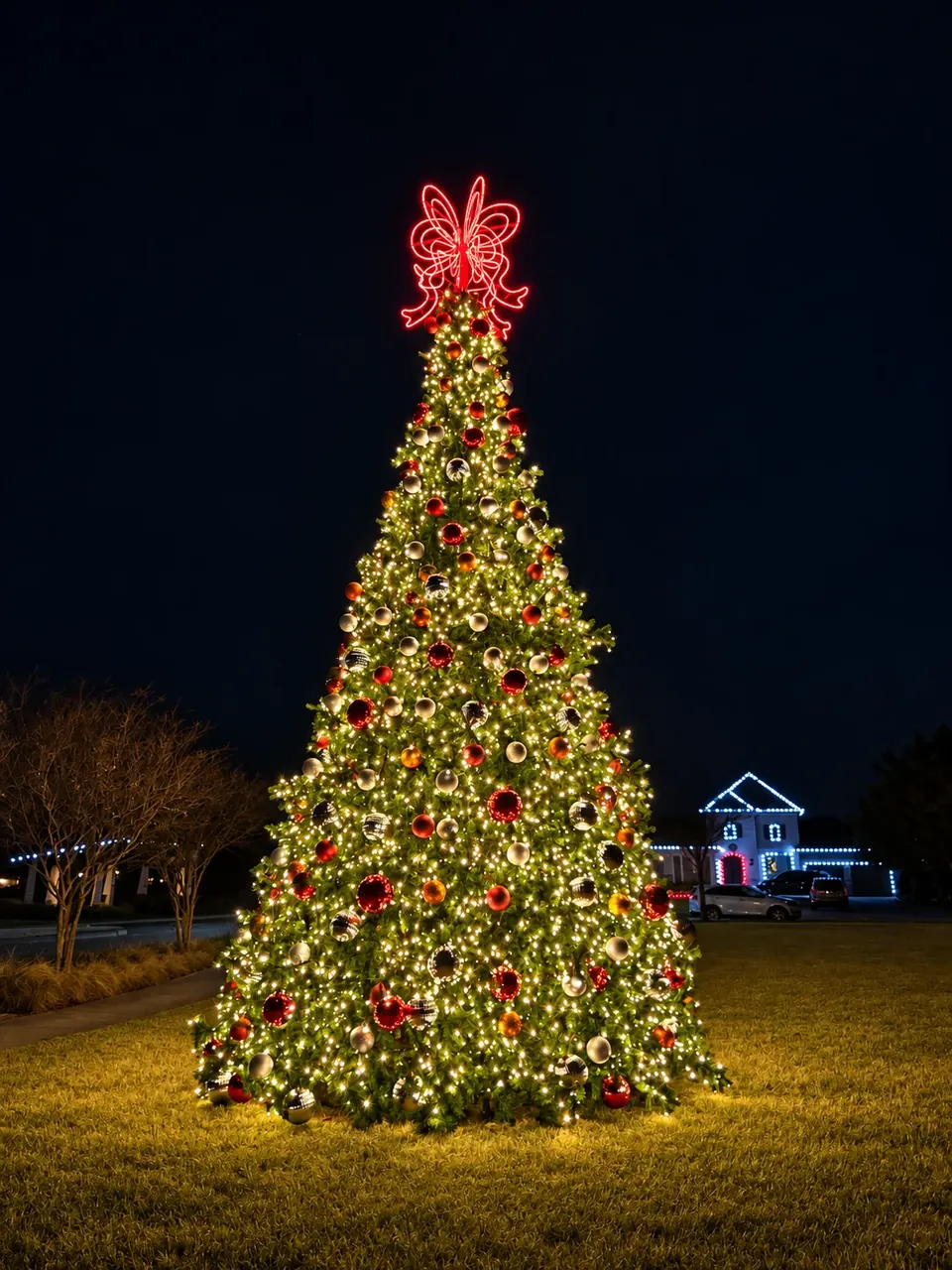
Our commercial gallery includes a tall decorated outdoor tree with warm white lights, red, silver and gold ornaments and a red bow topper. We’ll use it here as a reference for the kinds of choices you’ll make. Sizes, decoration options and installation requirements are confirmed for each property, so treat the photos as a conversation starter rather than a catalog.
Start with the view, not the height
Go stand where guests will first notice the tree. That might be the driveway entrance off the main road, the sidewalk approach from the parking lot, the view through a lobby window, or the edge of a pavilion lawn where people gather. Take a photo from that spot before you pick a location.
Each viewing position asks something different of the design:
- Roadside. Drivers see the tree briefly and from a distance. Check whether monument signs, hedges or parked cars will hide the lower third of it.
- Pedestrian approach. Visitors see it close up and often stop for photos. Look at the proposed spot from a few feet away and from wherever a family would naturally stand with the tree behind them.
- Gathering space. If the tree anchors an event lawn or courtyard, people will view it from several directions, so the back and sides matter as much as the front.
Write the goal down in plain terms. “A tree visible from the main entrance” leads to a different location and proportion than “a photo backdrop beside the pavilion.” That one sentence does more to shape a good estimate than any height number.
Plan for noon as well as seven o’clock
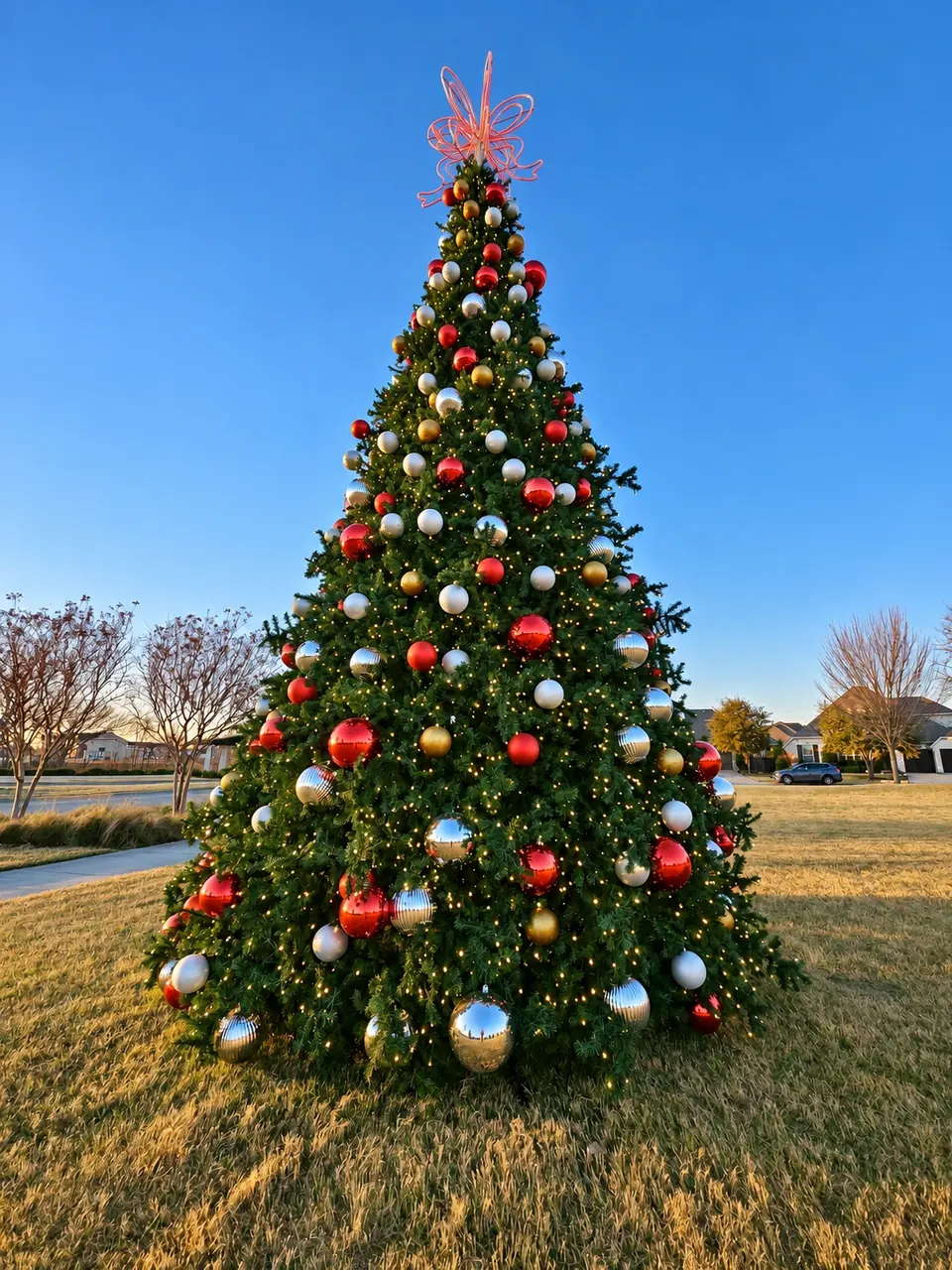
A tree on a retail property or office campus needs to work in daylight as well as after dark. During the day, the ornaments and the overall shape carry the display. In the daytime photo above, the red, silver and gold ornaments give the tree visible detail against the greenery while the lights barely register.
After dark the roles reverse. The warm white lights define the outline of the tree, and the red bow topper becomes the focal point people look toward from across the property.
When you describe what you want, send both a daytime and a nighttime reference if you can. “Warm white lights” tells us about the evening, but it doesn’t say anything about ornament colors, how densely they’re placed, the topper style or how the tree should read at lunchtime. If the tree needs to match wreaths, garland or decorations you already own, include photos of those pieces too.
Think about the job the tree is doing. A restrained palette that echoes the rest of your lighting ties the property together. A more colorful tree stands out as its own destination. Either works; the point is to decide on purpose.
Measure the whole footprint, not just the branches
The visible tree is only part of what has to fit. The base and support arrangement, the power route and the space our crew needs to work all take room, and none of that can be read off a photograph. It depends on the actual tree and the actual site.
Measure the usable area and note nearby doors, sidewalks, signs, parking spaces and landscaping. Then tell us a few things about the ground itself:
- Is the spot lawn, paving or an interior floor?
- Are there irrigation lines or underground utilities nearby?
- Does the property have rules about attachments, anchoring or disturbing the ground?
- Where is the nearest power, and who controls access to it?
The right support and electrical plan comes from those answers, not from copying another installation.
Finally, think about how people will move around the tree once it’s up. If visitors stop for photos, will they block an entrance or a fire lane? Will delivery and installation need to happen before opening or on a quieter weekday? Sharing your operating hours and busy periods lets us schedule around them instead of through them.
What to send with your estimate request
A clear brief saves a round of back-and-forth and gets you a more accurate quote. Gather:
- The property address and the name of the person who can approve the display.
- Wide photos of the proposed location, taken from the main viewing positions you identified.
- Available width and height, with nearby obstacles noted.
- Your preferred lights, ornament colors and topper style, with reference photos.
- Who the tree is for: passing traffic, arriving customers or people gathering nearby.
- Known power locations and any site or access restrictions.
- Your target ready date, any events the tree needs to be up for, and when it should come down.
For the broader coordination work (site contacts, access, installation timing and removal), our commercial holiday lighting checklist covers the full season. Think of this tree brief as the description of the display itself that sits alongside it.
What to expect from us
We use commercial-grade lighting and equipment on commercial projects, and we handle installation, seasonal maintenance and removal. Routine quality checks and ongoing maintenance are available on request, so tell us what level of attention your property needs rather than assuming a particular visit schedule comes with the tree.
On timing: October is generally a good month to book a first installation, November can still work, and by December the calendar usually offers fewer dates and options. Those are general expectations, not deadlines, but a large tree involves more coordination than a roofline, so earlier is better.
We work across North Texas from roughly Colleyville to Kaufman, and we confirm availability for your specific property address rather than by city name alone.
When you’re ready, look through our commercial holiday lighting service and project photographs, then request a free estimate. Text your site photos, the view you care about most and your target dates to (214) 557-7809, or email sales@texaspremierlighting.com. We’ll take it from there.